Data-Driven Success in Modern Business Consulting
Key Takeaways
- Data-driven consulting enhances decision-making and operational efficiency.
- Integrating AI and advanced analytics tools is crucial for modern consulting success.
- Effective data governance ensures data quality and compliance.
- Real-world case studies demonstrate the tangible benefits of data-driven strategies.
In today’s rapidly evolving business landscape, the ability to leverage data effectively has transformed how organizations compete and succeed. With vast quantities of business data now available, consultants who master advanced analytics can uncover crucial insights, optimize strategy, and increase measurable success for their clients. From process optimization to banking litigation support, the power of data-driven consulting is indispensable to today’s most successful firms.
Clients now expect consultants to go beyond generalized advice and provide clear, evidence-based recommendations grounded in data. Firms that embrace this trend are better positioned to help clients respond swiftly to market challenges, ensure compliance, and embrace emerging opportunities. Business leaders see profound improvements in decision-making and operational efficiency when they utilize analytics to guide strategy, customer experience, and risk management.
Importance of Data-Driven Consulting
Data-driven consulting enables businesses to make decisions supported by empirical evidence rather than gut instinct or guesswork. By analyzing patterns and relationships in large data sets, consultants can bring new clarity to operational inefficiencies, shifting trends, and customer expectations. Research has shown that companies that use strong data strategies often achieve significant improvements in cost savings, speed to market, and overall competitiveness. For instance, a recent study highlighted a 35 percent increase in operational efficiency in companies that deployed robust analytics within their first year.
Data-driven methodologies help businesses transition from reactive to proactive management. In highly regulated industries, such as finance, these approaches are essential for staying ahead of compliance requirements and for thorough risk management. When consultants rely on accurate, real-time data, they drive better results and foster stronger, trust-based relationships with their clients.
Integrating AI and Advanced Analytics
Artificial intelligence (AI) and advanced analytics are accelerating change within the consulting sector. By leveraging AI algorithms, consultants can process massive data sets in moments, revealing trends or anomalies that might otherwise remain hidden. These technologies enable advanced forecasting simulations, optimization modeling, and the generation of actionable insights more quickly than traditional manual methods. According to a Harvard Business Review report, 72 percent of executives believe AI will significantly improve decision accuracy over the next half-decade.
AI-Enabled Decision Making
The implementation of predictive analytics, natural language processing, and machine learning allows consultants to anticipate market movements and recommend strategies with confidence. AI doesn’t just process past data. It predicts future scenarios and provides a foundation for dynamic, adaptive business models. The result is greater agility and the ability to sustain continuous innovation.
Ensuring Effective Data Governance
As organizations expand their use of data, robust governance becomes critical. Data governance encompasses the policies, procedures, and technologies that ensure information is accurate, consistent, secure, and accessible. Effective governance enables businesses to harness data with confidence, knowing that security, privacy, and compliance risks are minimized. One recent case study found that companies that instituted comprehensive governance frameworks reduced IT dependency by 60 percent and improved data accountability across departments.
Data governance is especially relevant for organizations dealing with sensitive or regulated data, such as those in healthcare, finance, or international trade. By standardizing data management and embedding accountability, consultants help organizations safeguard customer information and maintain compliance with evolving legal requirements.
Real-World Success Stories
Leading companies are already witnessing the benefits of data-driven consulting. For instance, a global consulting firm recently modernized its data stack by moving analytics and reporting workflows to the cloud. The result was a 35 percent reduction in operational costs and a 40 percent decrease in data processing time. This enabled the firm to deliver faster, more precise insights, elevating its value proposition to clients and further embedding data-driven decision-making into its core offerings.
In another example, a retail chain adopted AI-powered demand forecasting tools. This switch enabled the company to improve inventory management, reduce waste, and increase customer satisfaction by keeping shelves stocked with in-demand items. The impact was a direct enhancement to both profitability and brand reputation in a very competitive market.
Future Trends in Data-Driven Consulting
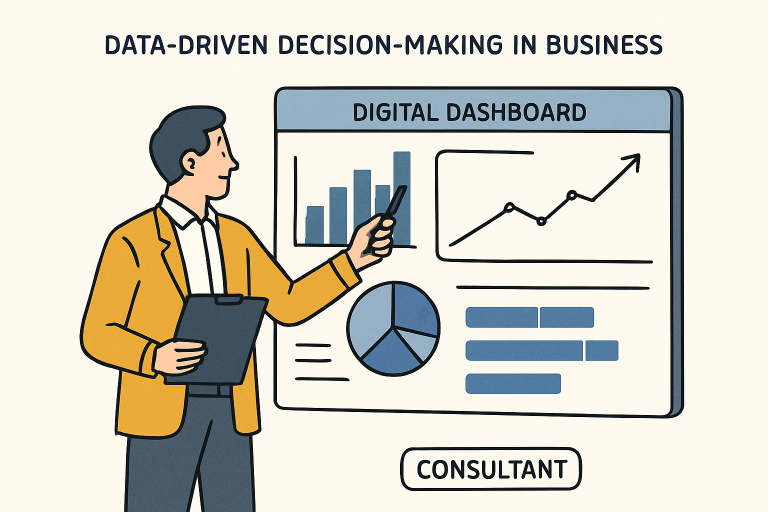
Looking ahead, digital transformation will continue to shape the future of management consulting. The adoption of cloud-based analytics, real-time dashboards, and AI-driven recommendations is becoming mainstream. Consultants must stay ahead of rapid advancements in automation, cybersecurity, and privacy regulations to effectively serve diverse industries.
Emerging trends point to a more integrated approach in which human expertise and digital intelligence work hand in hand. The next generation of consultants will increasingly function as data strategists, guiding clients through technology adoption while ensuring ethical, responsible data use. This dynamic environment will require ongoing upskilling and a commitment to transparency and client-centric values.
Final Thoughts
Modern business consulting has entered an era in which data is the foundation for sustainable growth. By integrating AI, advanced analytics, and strict governance practices, consultants help clients achieve unprecedented insights and performance. As client demands evolve and regulatory landscapes shift, consulting firms must double down on digital capabilities and data ethics to deliver value and maintain trust. Organizations that embrace a data-driven approach are not only surviving in competitive markets but thriving and setting new standards of excellence.